
Technological Personalities
The Promethean, The Atlantean, The Faustian

Technology is not just about the machines and devices programs and code that make up our favorite gadgets, appliances, and industrial machines. To truly appreciate technology, it is imperative to appreciate the interactions between these machines and the users. Between machines and humans. In fact, the relationship of technology is often even more important than the technology itself.
At this point, I’m required to reference Steve Jobs as the patron saint of user experience. I’m required to remind you that he revolutionized the computer industry by changing how the user relates to the computer, not by creating any new technology per se. The technologies which made up the mouse, the Graphic User Interface, the iPod, touchscreens, were all developed long before apple integrated them into any of its devices.
I have made a career out of my passion to analyze these sorts of interactions at a deep and specific level. In fact, many people have done this.
But what is often missed is the high-level, overarching archetypes which mediate how people relate to technology. Based on my research and experiences, people tend to have one of three dominant personalities. These personalities are not job titles or career paths, but fundamental orientations toward the technological world around us. Each person carries elements of all three, but one inevitably dominates the way they approach, think about, and engage with technology throughout their lives.
Understanding these personalities matters because they shape not just what work people choose, but how organizations function, how innovation happens, and how society moves forward. These are the Promethean, the Atlantean, and the Faustian.
The Promethean
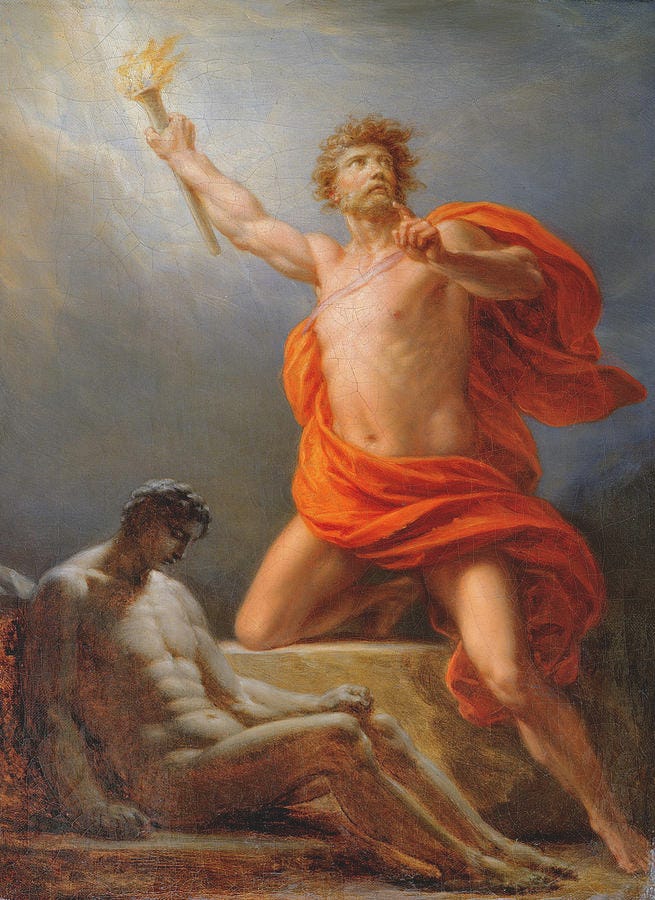
In Greek Mythology, Prometheus defied Zeus and brought fire from Mount Olympus to mankind. He was a gift giver and the chief benefactor of mankind. Similarly, the Promethean personality is defined by a single compelling drive: the need to bring something into existence that did not exist before, to benefit mankind. These are the inventors, the entrepreneurs, the people who look at empty space and see possibility. They do not improve what is. They create what is not.
Historically, the titans of industry and invention possess Promethean personalities Da Vinci, Franklin, Edison, Turing. These people are best known not just for their genius and their persistence, but also for the novelty and invention that they brought forward.
In terms of occupations, Promethean personalities are best identified with Entrepreneurs and inventors. Many developers fall into this category as well, though not all. The Promethean programmer is not the one maintaining legacy code or optimizing database queries. They are building the new framework, the novel architecture, the solution that breaks from convention entirely. Steve Jobs envisioning the iPhone. Thomas Edison with the light bulb. Grace Hopper creating the first compiler. These are Promethean acts.
Statistics on entrepreneurship suggest that nearly 20 percent of Americans are involved in some entrepreneurial activity. But true Promethean personalities are far rarer. No matter how successful you are owning an auto parts store is not a Promethean act despite putting you into the category of entrepreneur. True Promethean personalities at closer to 1 to 2 percent of the population.
The Promethean personality is marked by comfort with uncertainty, an almost reckless confidence in untested ideas, and a willingness to abandon stable ground, and persist in failure.
The Atlantean
Another Titan of Greek Mythology, Atlas held aloft the celestial heavens upon his shoulders. In ancient times he was venerated as the God of astronomy and navigation. His name is synonymous with order.
Unlike the Promethean personality, which is exceedingly rare, Atlantean personalities are far more numerous. In fact, most people have an Atlantean relationship to technology.
Atlantean personalities are the people concerned with the dexterous use of technology. Atlas was not worshiped because he created the heavens or made the sky higher, or lower, or more expansive. Atlas was steady and consistent and immovable. Therein lies his value to humanity. An Atlantean personality will not invent the blood pressure cuff, but with use it correctly, read it accurately, and apply it to patient care; nurses, accountants, administrators, actuaries. All of these roles require technological competence, but the emphasis falls on execution, not innovation. On doing the work, not reimagining it.
This is not a disparagement. Atlantean personalities are the reason anything works. They are the reason hospitals function, taxes get filed, students get educated, planes stay in the air. Without Atlantean personalities, every Promethean creation would remain an interesting, promising prototype gathering dust.
The Atlantean relation to technology is characterized by responsibility and care. These people learn their craft thoroughly. They follow procedures. They take pride in consistent, reliable execution. A nurse who can start an IV on the first attempt every time. A CPA who has a reputation of trust and honesty and closes the books without error quarter after quarter. These are Atlantean personalities at their finest.
Technology, for the Atlantean, is a tool to master and deploy. Not a puzzle to solve or a frontier to explore. The Atlantean personality keeps the lights on. They keep the gears turning. They hold everything together.
In a sense, the Atlantean relation to technology is the most plebian. It often lacks glamour. It lacks prestige. But it is absolutely essential. Without Atlantean personalities, there would be no civilization at all. After the galleys are built, they need rowing. The fields need tending. The technology needs competent hands.
The Faustian
Oswald Spengler characterized Western culture as fundamentally Faustian. To be Faustian means for existence to be forever linked with infinite striving, with the need to reach further, to extend, to improve without limit.
The Faustian personality is not a creator in the same way the Promethean personalities are. They do not birth the genuinely new or novel. But neither are they content with mere execution like Atlantean personalities. Instead, Faustian personalities take what exists and make it better, faster, smoother, more powerful. The Faustian impulse is toward extension and optimization. The Faustian reduces distance between problem and solution. They make things more efficient. They close gaps.
In terms of occupation, the Faustian is best embodied in the engineer. Most engineers do not invent anything new or novel. But they do continually improve and expand upon existing technology. The combustion engine was invented once, but through constant striving it gets more efficient year after year. Horseless carriages have become cars through the Faustian drive toward optimization. The same can be said for all other technologies, for there is not one technology that has not been affected by the Faustian drive for striving and improvement.
Consultants also exhibit Faustian traits. They enter organizations to identify inefficiencies and propose improvements. Supply chain managers work to shave days off delivery times. Software engineers refactoring code for performance gains.
Equal Necessity, Unequal Value
For any organization or society to function, all three personalities are essential. A world that was entirely populated with the Promethean personality would be a world where nothing works. Every system would be a perpetual prototype. Every process would be reinvented daily. No maintenance. No execution. Just endless creation of things that never quite function.
Likewise, the Atlantean personality would never create anything new and never improve upon itself.
A world populated exclusively with Faustian personalities is akin to a world of engineers. Nobody wants that. Enough said.
All three personalities are needed. But they offer drastically different value to society. The Promethean is rarest, most valuable, and rightly most prestigious. Their ability to fundamentally reorient and reorganize society is unrivaled. Their rarity increases their value.
The Atlantean is least glamorous. The work of Atlantean personalities do not embody novelty. And their status and prestige goes only as far as their consistency and execution as well as their inability to be replaced. As an example, consider a nurse. Nurses are well-regarded in society because of their outward care towards others, but also because of their consistency and high level of patient care, no doubt a product of good technology and training. Doctors are also Atlantean personalities, but command higher regard for the reason that they are scarcer, owing to high barriers of entry due to extensive training.
This hierarchy of value creates interesting dynamics. Atlantean personalities may resent being seen as mere executors. Faustian personalities may chafe at being neither creators nor the indispensable foundation. Promethean personalities may struggle in obscurity as they attempt to capture lightning in a jar. Indeed Promethean personalities are only known if they are successful.
Nevertheless all three are needed. Each plays an irreplaceable role.
Self-Selection: Personality Precedes Role
Where do these personalities come from? Do people develop these personalities based on their occupations, or do they select occupations based on pre-existing personalities?
The evidence strongly supports the latter. People have these technological personalities inherently, and they self-select into roles that match these orientations. Research on personality and vocational choice consistently demonstrates that personality traits influence career preferences, which in turn predict actual career choices.
Studies examining the Big Five personality traits have found that traits like Extraversion, Conscientiousness, and Openness significantly influence career role preferences and subsequent career fulfillment. These personality characteristics are relatively stable across the lifespan and begin forming early in childhood. Research tracking individuals from childhood to middle age shows that childhood personality traits predict occupational environments decades later.
John Holland’s influential theory of vocational choice, first articulated in 1959, posits that career choices are essentially expressions of personality. According to Holland, people gravitate toward work environments that match their personality dispositions. Vocational interests and personality traits both stem from combined genetic and environmental influences that become more differentiated with age.
Vocational interests are not random or purely environmentally determined. They exhibit stability comparable to personality traits and have similar genetic components. Twin studies suggest that genetic factors account for roughly 30 to 50 percent of individual differences in both personality traits and vocational interests.
What this means for our three technological personalities is clear. Individuals do not become Promethean, Atlantean, or Faustian through training or job assignment. These orientations exist prior to career choice and are innate to the persons themselves. A Promethean personality seeks out opportunities for creation and innovation. An Atlantean gravitates toward roles requiring reliable execution. A Faustian finds satisfaction in continuous improvement and optimization.
It is not possible to transform an Atlantean personality into a Promethean personality. Despite the panoply of training programs, leadership courses, and snake oils which promise to do exactly that. Both research and experience tell us that the distinct personalities are more rigid than Learning & Development grifters would have you believe. Attempts to force such transformations or elevate leaders up to visionaries is a task for fools. It is far better to recognize these innate personalities.
This does not mean personality is entirely fixed. More research shows some personality changes occur in response to life experiences, including work experiences. I started this article by conceding that every person has some elements to all of these traits. Certainly this might ebb and flow with life experiences, but the core patterns remain relatively stable. A fundamentally Atlantean person might develop some Faustian tendencies through years of engineering work, but they are unlikely to become predominantly Promethean.
As We Age, We All Become Atlantean
Here’s one caveat to self-selection: as we age, we all drift toward the Atlantean personality grows more dominant.
Youth favors the Promethean and Faustian personalities. Young minds are flexible, comfortable with uncertainty, energized by novelty. They have less invested in existing systems and fewer habits calcified around current technologies. They can more easily imagine alternatives.
This makes sense. We’ve all had the experience of helping our grandparents with technology or the humbling experience of a younger person dexterously work their way around a device in a way you didn’t even know was possible.
The research backs this up to Consider:
In chemistry, no scientist under the age of 40 has been awarded a Nobel Prize in the 21st century.
It really makes you wonder what all those old professors are doing at Universities. I digress…
This happens gradually and inevitably. As we age, cognitive flexibility declines measurably. The brain becomes more efficient at familiar tasks and less adaptable to novel ones. It is the difference between fluid intelligence (seen in younger people) and crystalized intelligence (seen in older people). We develop expertise in existing systems, which makes us competent but also committed to those systems.
The drift toward the Atlantean mode of thinking manifests in several ways. We become more focused on execution within established frameworks rather than questioning those frameworks. We value stability and reliability over innovation and risk. We prefer technologies we already understand over learning new ones. This is not merely conservatism or stubbornness, though those can be factors. It reflects genuine cognitive changes. The neuroplasticity that makes young brains so adaptable diminishes with age. The energy required to learn fundamentally new paradigms increases. The patience for failed experiments decreases.
This drift cannot be entirely avoided, it is part of our human physiology. Fighting requires deliberate effort: seeking out novelty, forcing oneself to learn new technologies, maintaining cognitive flexibility through diverse experiences. Some people manage this better than others. But the general pattern holds.
Understanding this drift matters for individuals, organizations, and society. For individuals, it suggests the importance of leveraging Promethean and Faustian energies while they are still strong. The innovations and optimizations of youth often become what occupies us in the Atlantean work of age. For organizations and society, it means recognizing that younger people bring different technological orientations than older ones, not because of generational preferences but because of fundamental cognitive changes across the lifespan.
There is wisdom in Atlantean maturity. Experience, judgment, patience. But there is also loss. The willingness to tear down and rebuild. The comfort with radical uncertainty. The energy to pursue the unprecedented.
Personalities and Errors
Each technological personality has characteristic flaws. Consistent weaknesses and modes of failure. Understanding these helps individuals compensate for their weaknesses and helps organizations structure work to minimize these typical errors.
The Promethean Recklessness and Hubris
Promethean personalities err through excess. Their greatest strength, the willingness to create the unprecedented, becomes their weakness when untempered. Recklessness is the first characteristic flaw. Promethean personalities move fast and break things, as the Silicon Valley motto once celebrated. But breaking things has costs. Rushing to launch products before they are ready. Ignoring safety concerns in pursuit of innovation. Disrupting functioning systems without adequate replacements.
Hubris follows closely. The Promethean who has succeeded once or twice begins to believe they cannot fail. They stop listening to warnings. They dismiss concerns as timidity. This leads to spectacular failures: companies destroyed by overreach, products that harm users, innovations that create more problems than they solve.
Finally, and perhaps most abundantly, Promethean personalities often deliver unfinished or suboptimized creations. Their energy focuses on the act of creation itself. Once the essential innovation is achieved, their interest wanes. They move on to the next project, leaving behind prototypes that require enormous Faustian and Atlantean effort to make functional and reliable.
The Atlantean Mediocrity
Atlantean personalities face different risks. Their commitment to reliable execution within established systems becomes a trap when those systems are badly designed or when circumstances demand innovation.
Burnout and mediocrity are the primary Atlantean flaws. Executing flawed processes, day after day, without the ability to change them. Maintaining outdated technologies because that is what the role demands. Hitting metrics that no longer matter while knowing the underlying work is inefficient. This grinds people down.
Quiet quitting is a phenomenon that made the news a few years ago. It could only be a phenomenon of the Atlantean personality. The Atlantean continues executing but without care or pride. They do the minimum required. They stop suggesting improvements. They punch in, punch out, collect their paycheck. How foreign and unthinkable this would be to the Faustian or Promethean personality.
The Faustian seeds to its own demise
The Faustian personality is famously the most tragic.
The Faustian personality knows no finitude. There is always more to optimize, always another marginal improvement to pursue, always further reach. This becomes compulsive and consumptive. The Faustian optimizes for the sake of optimization, losing sight of whether the optimization actually matters.
The Faustian orientation can become the cause of its own demise. The relentless pursuit of improvement prevents ever declaring something finished, good enough, complete. Perfect becomes the enemy of good. The Faustian engineer who continually refactors code that already works. The consultant who recommends process changes that exceed the organization’s capacity for change. This is the terminus which Spengler predicted of Western Civilization, which seems manifestly true.
The Faustian loses sight of the forest through focusing on individual trees. Each optimization makes sense in isolation. Collectively, they create complexity, fragility, and exhaustion.
Technology Among Three Personalities
These three technological personalities, Promethean, Atlantean, and Faustian, shape how individuals engage with the technological world and in turn, how the technological world is shaped and developed. Understanding them provides insight into career choices, workplace dynamics, and societal innovation patterns.
None of the three is superior in all contexts. Each has its place. Each has its characteristic strengths and weaknesses. The Promethean creates but may not finish. The Atlantean executes but may not innovate. The Faustian improves but may not know when to stop.
Individuals can recognize their own dominant personality and understand both what roles will satisfy them and what pitfalls they should guard against. Promethean personalities should seek creation opportunities but partner with those who can execute and refine. Atlantean personalities should pursue mastery of execution but advocate for process improvements. Faustian personalities should embrace optimization work but develop judgment about priorities.
The key insight is that these personalities reflect fundamental orientations, not learned behaviors. They emerge early, change slowly, and shape lifelong patterns of engagement with technology. Trying to force people into ill-fitting relationships to technology wastes potential and creates frustration. It is better to understand these personalities, respect their differences, and structure work to leverage their distinct strengths.
The Promethean brings fire from the gods. The Atlantean keeps the world functioning. The Faustian extends our reach ever further. All three are necessary. All three are human. All three are how we, as technological beings, navigate and shape the world.
I've always felt strongly about the triad described, but have not been able to put it into words. Beautiful essay! Which one are you?
Thx. Liked this a lot. Maybe these archetypes are also a good lens for choosing a target audience. You mention Faustians mistaking forest for trees. That would be my milieu.