
Signal Detection Theory
A fundamental idea for systems thinkers and designers


Imagine a typical day walking around a city. Along the way you may pass a construction site and hear the cacophony of construction sounds like jackhammers, drills, cranes, materials crashing into one another. Maybe you also hear a noise cut through everything else: a sharp beep of a truck backing up. You decide to wait.
Passing the construction site, you come to an intersection. The pedestrian traffic light illuminates a green silhouette of a person, and a chirping noise radiates from a nearby post. You determine it is safe to walk.
You walk into a café, place an order, and are handed a device that will vibrate and chime when your order is ready. Before you’re finished eating, somebody pulls the fire alarm. Lights flash, a loud blaring sound bursts into your ears, and you quickly evacuate.
Bells, chimes, horns, beeps, lights, and signs are pervasive elements of daily life. As this brief vignette demonstrates, each of these stimuli, the train whistle, the buzzer, the truck beeping as it backs up, demands a decision and response. These stimuli allow us to direct our attention, make decisions, and then revert back to a low state of effort and awareness.
This is not accidental. It is not mere convention or habit. It is, in fact, the product of a rigorous decision-making science, and one with profound implications for how we build systems, design organizations, and think about human performance. That science is called Signal Detection Theory.
The Mind is a Change Detector
To understand why Signal Detection Theory matters in systems design, we must first understand a crucial feature of human cognition: the coherence principle.
At a high level, the coherence principle states that we try to maintain a coherent “picture” of the world. This allows us to be efficient, using the least number of resources to constantly reorient ourselves to our environment. Relatedly, this isn’t just true of how we perceive our physical environment, but also applies to our internal knowledge and beliefs. Confirmation bias, the tendency to hold on to initial hypotheses and find evidence for their support, even despite contradictory evidence, is a product of this coherence feature of cognition.
This also means that our minds are not optimal for maintaining full situational awareness (!). Instead, the human brain is better thought of as a change detector. We seek out stimuli which signal changes in the environment, and this helps us determine how best to respond. This is efficient not only because we can respond to acute stimuli quickly, but also because our “picture” of the world will remain unchanged except for the immediate subject under scrutiny.
For systems designers, this is no mere peripheral observation. It is foundational to everything we design and develop. Every system that interacts with human beings is, at some level, a system that must work with (or against) this cognitive architecture. Ignore it, and your system will produce confusion, error, and frustration. Work with it, and your system becomes intuitive, safe, and effective.
Signal Detection Theory
Signal Detection Theory (SDT) is a framework for understanding how decisions are made, particularly in circumstances of uncertainty. The framework is widely used in fields like psychology, medical diagnostics, engineering, and military applications. The ideas are also directly germane to systems thinking and systems design.
For any situation where a system or environment changes, there exist three fundamental elements: noise, signal, and cutoff points. I’ve drawn you a little picture of how this looks below.
Noise is the element of the status quo. It is the current state of the environment. You mostly pay no attention to it, because as we mentioned, we are focused on detecting change. It is akin to the din of conversation, music, and clanging dishes at your favorite local café.
Signals indicate a change in the environment. In some instances, you may detect the signal; in others, you may not. If somebody whispers “Fire” in the café, you’re unlikely to recognize the signal. If the same person stands on a table and yells “Fire!” you are much more likely to recognize this as a signal and respond.
The cutoff (or criterion) is the threshold where the signal is different enough from the noise to allow you to detect changes in the environment. In the second instance, the person yelling breaks the threshold of the cutoff. In the first instance, whispering does not.
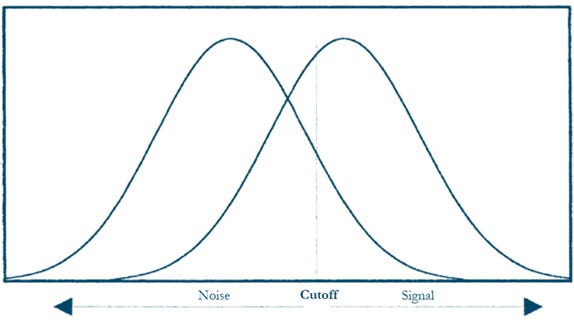
Now, in my picture, you’ll notice that the “signal” bell curve is further to the right of the “Noise” bell curve. You’ll also notice that I was too hasty to label my axes. We could call the x axis “Attention” or “Internal response” and as we should expect the signal correctly gets more internal response than the noise.
However they are bell curves, there is a randomness to them. We don’t know if the signal will always get the same internal response, and we don’t know if it will always come through more than the noise.
The Four Possible Outcomes
The leads us to a few possible outcomes. From any given moment of perception, four possible outcomes can result:
Correct Rejection: There is no signal, and you correctly did not detect one. The system is stable, and you treat it as such.
Hit: There is a signal and you correctly detect it. This is the ideal outcome when a change has occurred.
False Positive (False Alarm): There is no signal, but you incorrectly detect one. Disruptive and inefficient, but rarely catastrophic.
False Negative (Miss): There is a signal, but you do not detect it. This is the most dangerous outcome, and the one that systems design must work hardest to prevent.
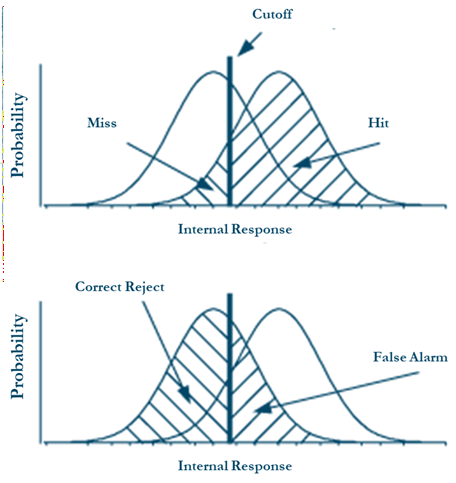
Clearly, two of these scenarios are good, one is bad, and one is very bad. Correct rejections and hits are the desired outcomes. False positives are not desirable, but they are merely disruptive and lead to inefficiencies, nothing more. We’ve all had the feeling of a phantom cell phone vibrating, or been unsure whether or not we heard a knock at the door. The consequences are not catastrophic. However, false negatives usually carry far more dire consequences — a missed alarm, a missed warning, a missed signal from a train or an automobile.
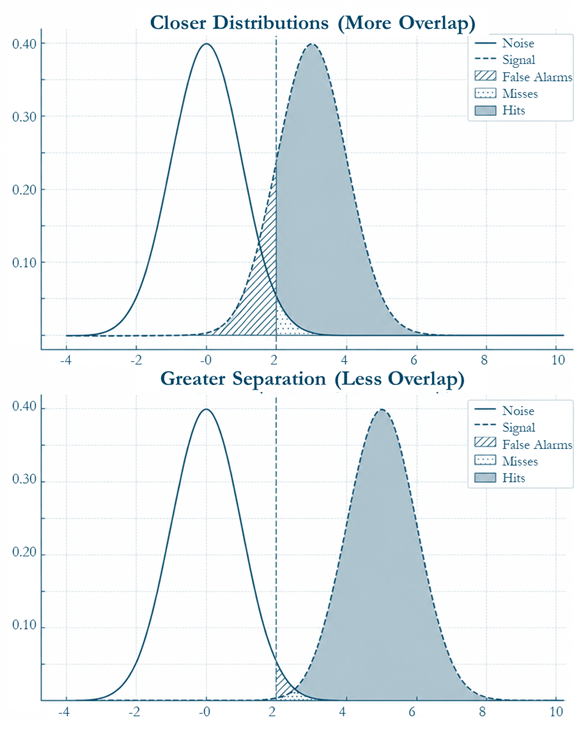
My picture, now well-labeled, clearly shows when each of these instances occur. Not that the errors occur in the overlaps. This makes intuitive sense: we would only mistake one for the other when they are eliciting the same level of internal response. If the overlap between noise and signal is decreased, the opportunities for misidentification drastically decrease. Discrimination between signal and noise becomes easier.
Why This Matters for Systems Design
Whether applied to manufacturing operations, digital software, hospital workflows, or organizational processes, systems design is fundamentally a human endeavor. Systems are operated by, interacted with, and depend upon human beings. And human beings, as we’ve established, are change detectors operating within the framework of signal and noise.
This means that every system generates its own signal environment. Every alert, notification, error message, dashboard indicator, and status light is a signal. Every background process, ambient condition, or routine state is noise. The ratio and clarity of signal to noise in a system determines, in large part, how reliably and safely that system will be operated.
When systems are poorly designed from an SDT perspective, the consequences are predictable: operators miss critical events, alert fatigue sets in, errors increase, and cognitive overload becomes the norm. When systems are well designed, the opposite occurs and people can quickly orient to what matters, respond effectively, and return to a state of low-effort awareness.
Before we venture into actual strategies of systems design, one last final note on SDT. If there is less overlap we have less errors. What this means then, is that we should increase the distance between the noise and signal bell curves, either by decreasing the ambient noise, increasing the clarity of signals, or both. My picture, once again missing the axes labels, but now with a prettier legend, demonstrates this well.
Signal Enhancers
The application of SDT to systems design centers on what we can call signal enhancers. Signal enhancers are stimuli that amplify signals already present in a system. They signal a change to the system or environment and induce (though do not compel) a response. My novella at the beginning of this post, with beeps and flashing lights are all examples of signal enhancers.
Signal enhancers fall into three primary categories, each with distinct characteristics and applications:
Auditory stimuli deal with sound-based notifications. Examples abound from traffic sirens to heart monitors in hospitals, trucks backing up, tornado sirens, smoke detectors, and even the ringing of church bells calling parishioners in. Though it is not practiced often, auditory signals can also be used to issue commands, such as telling pedestrians to “WAIT” at an intersection.
Visual stimuli are the preferred type of signal enhancer in most designed environments, given the speed at which the mind processes visual information. Lights are widely used in all areas of life. A stovetop might have a light indicating if it is still hot. Different industries make use of lights as well — from the “on air” recording light of radio disc jockeys, to a barista’s indicator letting her know that the espresso machine is warmed.
Textual stimuli are used very often, particularly in digital settings. Any time you receive an error code, a dialog box pops up, or you’re notified that your computer needs to restart, you are essentially receiving a text-based stimulus. Textual stimuli require processing of meaning to generate a response, but they can provide greater specificity and direction than purely auditory or visual signals.
It’s important to highlight that these types of signal enhancers are not mutually exclusive. They can be combined together to increase their effectiveness. It comes as no surprise that areas of critical decision-making use multiple aspects of signal enhancement. Fire engines don’t just have sirens they also have flashing lights. Computer dialog boxes often appear in conjunction with a sound notification, and sometimes even with the program icon flashing in the toolbar. Combining these elements creates much greater distance between noise and signal.
Strategies for Applying Signal Enhancers in Systems
In addition to the different types of stimuli, there are also different strategies for applying them. Which strategy is used depends on several factors like how much control you wish to give the individual, how long the signal is relevant, and whether a particular behavior is required or merely desired.
Notification utilizes signal enhancers to inform an operator that environmental or system conditions have changed. Construction signs with “Workers Present” or email messages telling you how much cloud storage you have remaining are examples of this strategy. They allow the individual to determine if a response needs to be taken, and what that response should be.
Deterrence creates inconveniences or future inconveniences if an action is performed. A gate in front of a train track is quite easy to go around — but it creates an inconvenience of steering the vehicle in a serpentine manner. This maneuvering makes the driver less confident they can cross the tracks before the train arrives, and therefore acts as an effective deterrent. While there is some constraint put on the individual, the individual is still in control of their decisions and behaviors.
Annoyance uses a constant or frequent notification to coax the user into a desired behavior. The notification continues until there is compliance with the preferred course of action. Seatbelt alarms are an excellent example: the lights on the dashboard and the constant beeping are enough to get most people to buckle their seatbelts, even if it’s simply to make the notifications stop.
As each of these strategies indicates, the use of signal enhancers can be effective. By deploying different strategies suited to each situation, signal enhancers can help cut through the noise, focus attention on what matters, and even coax behavior out of individuals. It’s important to remember, however, that these tools still rely on the individual to take the correct course of action. This limitation can be a blessing or a curse.
When Signal Enhancers Fail
Signal enhancers can be effective. But there are certain circumstances and use cases that greatly diminish their capacity to coax desired behaviors. Systems thinkers must be acutely aware of these failure modes.
Signal Overload
When enhancers work in concert, they reinforce the signal and make it easier to detect and discriminate from noise. However, there are environments where too many signals, not acting in harmony with one another, drastically decrease their efficacy.
In many factories and retail stores, forklifts will have a beeping noise to indicate when they’re backing up. In warehouse environments, these sounds are typically turned off. Why? With dozens of forklifts picking items from racks and transporting them, the noise would be non-stop, incessant, and disorienting. Because the beeping is so prevalent, the sounds themselves become part of the environment. They become the noise. As soon as signals become the noise, they stop being effective signals.
This principle extends directly into organizational and digital systems design. Dashboards overloaded with red alerts lose their power. Inboxes flooded with automated notifications breed the same selective blindness that warehouse workers develop to forklift beeps. The system that cries wolf constantly will be ignored when the wolf truly arrives.
Inability to Act
Another critical limitation is when the individual doesn’t have the ability to act or respond based on the signal. In this instance, it doesn’t matter how pronounced the signal is because the person cannot take appropriate action, or cannot do so in the time required. Any notification will simply cause resentment and frustration.
In organizational systems, this manifests as alerts sent to the wrong level of the hierarchy, warnings delivered without the authority or tools to resolve them, or dashboards that surface problems that no team is empowered to fix.
Ambiguous Response
Similarly, you may encounter signals where the desired behavior is ambiguous. The individual has the ability to respond, and may even want to comply with the desired behavior, but cannot determine what that behavior is. Ambiguous signals are no good, yet they are surprisingly common in complex systems, where warnings are triggered without clear resolution pathways, and error messages are generated without actionable guidance.
Signal Detection Theory In Systems Thinking
Beyond its direct application to the design of alerts and interfaces, SDT offers something more powerful: a fundamental lens through which to evaluate any system’s capacity to support human decision-making.
Every system produces a signal environment, a ratio of meaningful information to ambient noise. The quality of a system is, in large part, a function of how cleanly it presents signal relative to noise. A well-designed system makes the right things obvious. A poorly designed system buries the right things in irrelevance.
This principle applies with equal force across wildly different domains. In healthcare, the design of clinical dashboards and alarm systems directly determines whether nurses and physicians detect deteriorating patient conditions in time. In aviation, the careful calibration of cockpit warning systems is the difference between a recoverable situation and a catastrophe. In manufacturing, the layout of visual management systems on a factory floor determines whether abnormal conditions are spotted immediately or discovered after the damage is done.
In each of these domains, the core question is the same: How easily can a human being, operating within the normal constraints of attention and cognition, detect a meaningful change in this system’s state?
Signal Detection Theory gives us a rigorous vocabulary and framework for answering that question. It reminds us that:
• The cost of a false negative (a missed signal) is almost always greater than the cost of a false positive (a false alarm).
• The overlap between signal and noise is the enemy. Anything that increases the separation between signal and noise improves the system’s safety and effectiveness.
• More reinforcing stimuli will always be better, and the marginal time and cost to incorporate multiple signal enhancers is negligible compared to the cost of a miss.
• If we can expect more stimuli for a given signal — a greater distance between signal and noise — we can set a higher cutoff threshold, being more conservative about what constitutes a signal, further reducing errors without sacrificing hits.
Why Signal Enhancers Beat Standards and Signs Alone
Standards and signs suffer from a fundamental limitation: there is no mechanism to coax or direct behavior in a particular direction, especially in the face of expediency, preference, or habit. The best standards, the most organized workplace, the highest-trained person, and the best job aids will not help somebody who prefers to go their own way.
Conversely, signal enhancers, particularly when using the strategies of deterrence and annoyance, reset the scales of preference. You may not prefer to buckle your seatbelt. But you do prefer to buckle your seatbelt rather than listen to constant beeping while you drive. The signal enhancer doesn’t override free will — it reshapes the calculus of convenience.
Aside from preventing deviant behaviors, signal enhancers are also effective tools to aid in doing the right thing and preventing honest mistakes. The distancing of signal from noise makes it easier to identify decision points, decreasing slips and lapses in the skills-based level of cognition, as well as mistakes while operating in the rules-based cognitive level. In other words, SDT-informed design reduces both intentional workarounds and unintentional errors simultaneously.
Human Centered Design
Signal enhancers are some of the most pervasive and often-used ways humans and machines interact. They can make a decisive impact on our ability to navigate and respond to our environment and the goings-on of technologies. When used tactfully, auditory, visual, and textual stimuli can lead to greater safety and productivity by improving our focus on what is relevant, decreasing cognitive errors, and helping us make better decisions.
But their effectiveness can be limited. Factors such as signal overload, inability to act, or ambiguous responses will severely restrict their impact. Excessive signals blend into background noise, diminishing their power. A dearth of clarity in what to do or the inability to act can render even the most noticeable signals ineffective.
To maximize their utility, it is essential to think strategically about the implementation of signal enhancers. Whenever possible, combine multiple stimuli to increase the distance between signal and noise. Use the strategies of deterrence, annoyance, and notification in situations that will yield the greatest results, while also balancing adjacent factors like response time, risk, severity, and desired behaviors.
The human mind is a change detector. Every system that interacts with human beings must reckon with this fact. Signal Detection Theory gives us the tools to do so — not as an abstract psychological curiosity, but as a practical design discipline. Through thoughtful application and design, signal enhancers can significantly improve productivity, situational awareness, and response accuracy in a wide variety of contexts.
You read the whole article!
it was free!
Please:
Really enjoyed this. Another layer I might add is that humans are also tuned by evolution to detect threats and opportunities. That's another relevance filter determines which signals break through and which fade into noise. It could be a helpful complement to SDT when thinking about why some alerts work and others get ignored.