
Automation Conundrum: The Narrow Window of Machine Performance
Why automation performs brilliantly in a narrow range and fails catastrophically outside it


Much has been made about Artificial Intelligence, especially its impact on work, but if you look beyond the shimmer of the shiny new gadget, you’ll see the same mechanisms shaping the interplay between man and machine that have existed for generations.
At its core, AI like many other modern technologies (Robot Process Automation, Driverless Vehicles, Factory Robots, etc.) are tools of automation. They speed up a system, they take the human person out of the picture, and they, ideally, perform with greater speed, quality, safety, and make better decisions than humans would. In short, the value offered by these modern, revolutionary technologies is the same value as the steam engine offered in the 18th century.
Yes, the technologies of today are more sophisticated. Even the acclaim that AI has merited has come from an expansion of applications (specifically into white collar work) of this sort of automation rather than a wholly new dynamic of human-computer interaction. They may make better decisions, have greater applications, maybe even uncover patterns and insights not seen by humans, but the difference is in degree, not in kind. We gain value through technology’s ability to automate.
Historical Perspective
This is a very good thing. For several generations we’ve been working with automation. Consequently, we have a corpus of knowledge on the subject, created by the sharpest minds to study automation and human-machine interaction. These experts have done a good job of explaining the best ways to use automation to meet goals and objectives while also decreasing risks like safety and quality.
One such luminary is the electrical engineer, Jens Rasmussen. We were introduced to Jens earlier in this book when we discussed the SRK framework. As a pioneer in the field of human factors, Jens Rasmussen wasn’t just interested in cognition and problem solving, but also the way people interact with machines. One of his most insightful ideas was a way to think about the potentials of automation as well as the risks. He called this the Automation Conundrum.
The Automation Conundrum
At its core, the Automation Conundrum encapsulates an interesting paradox—an intricate dance between the capabilities and limitations of automation. Rasmussen’s automation conundrum illuminates aspects of the optimal design of the system.
When automation works, it really works. It outperforms humans in all the critical dimensions like safety, quality, and productivity. It has superhuman levels of performance. But when it doesn’t work, it actually underperforms, not just compared to the high water mark it has set for itself, but even underperforms what a normal person can do.
Moreover, the window for good automation performance, the optimal design domain (ODD), is very narrow. Comparably, humans are more adaptable to different work conditions, changes to environment, customer specifications, alignment, and visual differences that plague even the most intelligent and sophisticated technologies. In other words, humans can maintain a relatively consistent level of performance across many different scenarios.
Visualizing the Conundrum
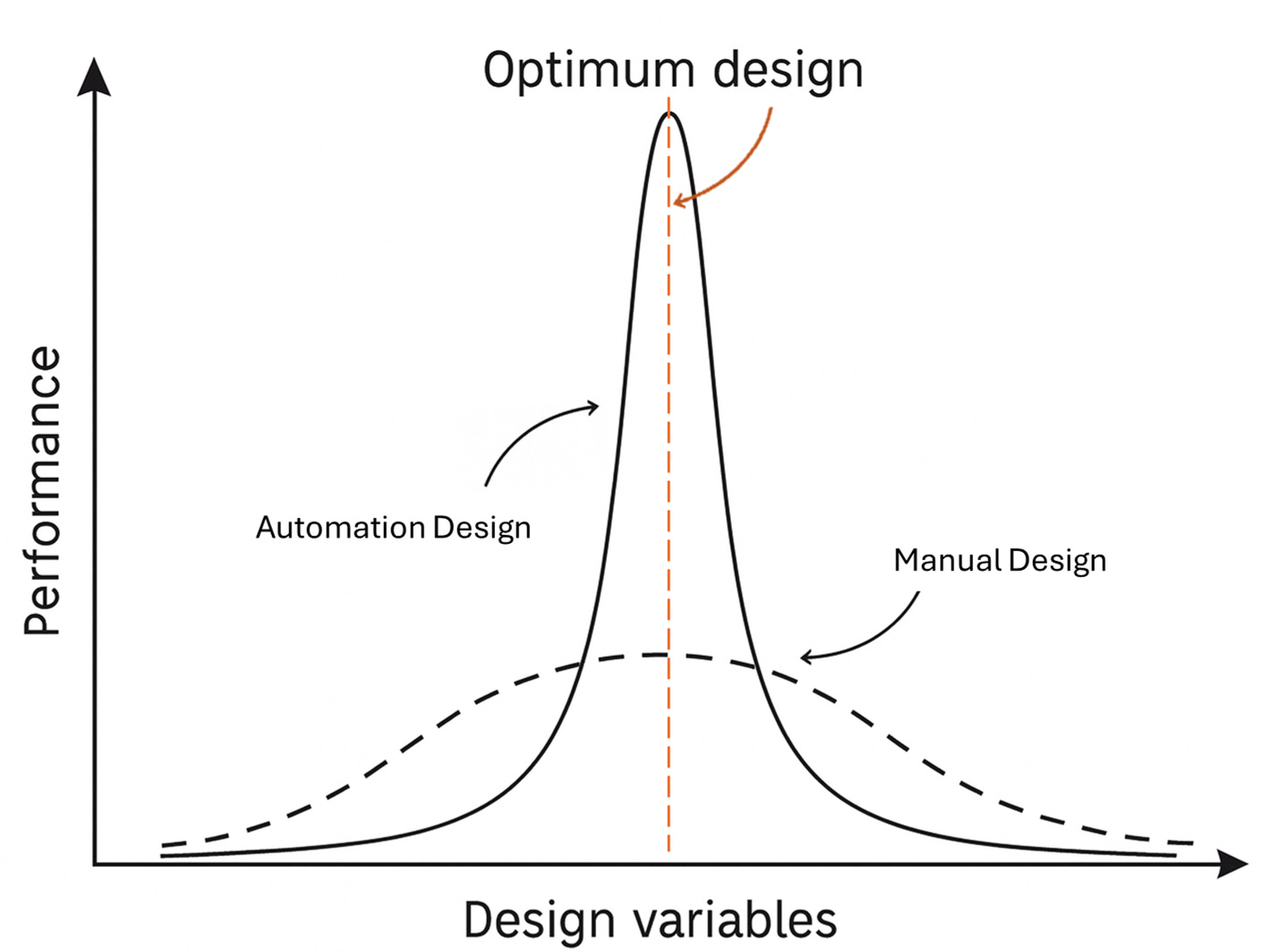
The graph above is a visual rendering of the conundrum. Notice:
Automation’s Performance Curve:
Peaks dramatically within narrow optimal conditions
Drops sharply outside those conditions
May fall below acceptable thresholds entirely
Creates a tall, narrow spike of excellent performance
Human Performance Curve:
Lower peak than automation at optimal conditions
Maintains moderate performance across wide range of conditions
Degrades gradually rather than catastrophically
Creates a low, wide plateau of acceptable performance
There is no “better” in this formulation of system design. It will depend on the purpose and application, and needs of the system.
Real-World Manifestations
We’ve seen the conundrum play out time and time again in various domains:
Driverless Vehicles
Autonomous vehicles can drive with superhuman precision on well-marked roads, in good weather, with clear sensor visibility. They maintain perfect lane position, optimal following distance, and never get distracted or tired. Within their ODD, they are remarkable.
But they are rendered useless once the surrounding infrastructure fails below any level but pristine. Snow covers lane markings? System failure. Construction cones create ambiguous boundaries? System failure. A person directing traffic with hand signals? System failure. Unusual road surfaces or lighting conditions? System failure.
A human driver, while not achieving the same precision as the autonomous system in ideal conditions, can adapt to all of these scenarios with moderate performance. The human doesn’t suddenly become unable to drive; they just drive more carefully.
Voice Assistants
Voice assistants work remarkably well in quiet rooms with clear speech. They understand context, complete tasks, and respond appropriately. Their performance in these ideal conditions often exceeds what a human assistant could provide in terms of speed and availability.
But they fail dramatically in the presence of several people talking, while loud music is playing, or sometimes even in the car (a controlled environment) when there is excessive noise from the road or other passengers. Add background noise, regional accents, unusual speech patterns, or ambiguous requests, and performance collapses.
A human assistant might need you to repeat yourself or lean in to hear better, but they don’t become entirely non-functional. They adapt, ask clarifying questions, and use context to understand despite imperfect audio conditions.
Industrial Automation
Manufacturing robots perform identical tasks with superhuman precision and speed. No variation, no fatigue, no errors—as long as the parts arrive in exactly the right orientation, at exactly the right time, with exactly the right specifications.
But introduce variation with a part that’s slightly rotated, a different material thickness, an unexpected jam and the robot often cannot adapt. It requires human intervention to reset, reprogram, or work around the problem.
A human worker, while slower and less precise in the nominal case, can adapt on the fly. They notice the rotated part and adjust their grip. They feel the different material and modify their technique. They see the jam developing and prevent it before it becomes critical.
Why the Narrow Window?
The fundamental reason for automation’s narrow performance window is that automation is designed for specific conditions and lacks general adaptability.
Automation works by encoding specific solutions to specific problems. It optimizes for known scenarios. It follows rules, patterns, or learned behaviors that work brilliantly within their training domain but have no mechanism for reasoning outside it.
Humans, by contrast, have general intelligence. We can:
Recognize when conditions have changed
Draw on analogous experiences
Reason about novel situations
Adapt our approach in real-time
Combine multiple types of knowledge
Apply common sense and intuition
This adaptability comes at the cost of peak performance. We’re not as precise, fast, or consistent as well-designed automation. But we’re also not as brittle.
The Design Implications
Rasmussen’s conundrum leads us back to look at systems design and the propensity of design decisions, such as automation and technology, to generate and propagate latent failures.
As a prudential rule of thumb, decisions to bring automation into a system should only be done when we can be assured that the system will always fall within the ODD or that thorough and supplemental mechanisms are in place to build a more resilient system when the system falls outside of the ODD.
This means several things practically:
1. Understand Your Operating Conditions
Before deploying automation, honestly assess:
How often will conditions be ideal?
What causes conditions to deviate from ideal?
How predictable are those deviations?
What’s the cost of failure when conditions deviate?
If your answer is “conditions are usually ideal,” proceed carefully. If your answer is “conditions vary significantly,” proceed very carefully or reconsider entirely.
2. Design for the Exception, Not the Rule
Many systems are designed assuming normal operation with exception handling as an afterthought. The conundrum teaches us to reverse this: design for the exception cases because that’s where automation will fail and human performance will matter most.
This means:
Clear handoff protocols when automation reaches its limits
Transparent system states so humans understand what’s happening
Preserved human skills through regular manual operation
Redundant capabilities for critical functions
3. Match Automation to Task Characteristics
Some tasks are well-suited to automation:
Highly repetitive with little variation
Operating in controlled, stable environments
Where the ODD can be maintained reliably
Where failure consequences are manageable
Where human performance adds little value
Other tasks are poorly suited to automation:
Require adaptation to novel situations
Operating in dynamic, unpredictable environments
Where maintaining the ODD is difficult or impossible
Where failure consequences are severe
Where human judgment and reasoning are critical
4. Recognize the Total System Performance
The conundrum teaches us that we must evaluate the entire system performance profile, not just peak performance. A system that performs at 95% efficiency 99% of the time but completely fails 1% of the time may be inferior to a system that performs at 80% efficiency 100% of the time.
Consider:
Average performance across all conditions
Worst-case performance in adverse conditions
Frequency of different operating conditions
Cost of different types of failures
Ability to recover from failures
The Conservative Principle
The lesson from Rasmussen’s Automation Conundrum is to rely on automation only when you can ensure that it will stay within the range of optimal performance. This calls for conservative decision-making.
The selection of a technology should not simply be based on what it can do. It should also be evaluated based on:
Its maintainability
Its adaptability
Its integration into the system
Its resiliency to changing circumstances and environments
This may require deep technical knowledge as well as knowledge of the system, so it’s imperative that technological decisions are made with the utmost care and only after gathering all of the facts.
The Seduction of Peak Performance
One of the greatest challenges in applying Rasmussen’s insight is that peak performance is seductive. When you see automation performing at superhuman levels, it’s natural to be impressed and to want to deploy it widely.
Demonstrations and pilots typically occur under ideal conditions—within the ODD where automation shines. These showcase the impressive spike of the performance curve while hiding the steep drop-offs on either side.
Decision-makers see the peak and assume that represents typical performance. They don’t adequately consider:
How often real conditions will match demonstration conditions
What happens when conditions drift from ideal
Whether the system has any capacity to recognize it’s outside the ODD
What the recovery path looks like when automation fails
This is how we end up with:
Driverless vehicles that work great in Arizona but fail in Boston winters
Voice interfaces that demo beautifully in quiet rooms but frustrate users in real environments
Automated trading systems that excel in normal markets but crash spectacularly during unusual conditions
AI systems that perform well on test data but fail when deployed to messier real-world data
The Human-Automation Partnership
The conundrum doesn’t mean we should avoid automation. It means we should deploy it wisely, understanding its limitations as clearly as its capabilities.
The goal is not to choose between humans and automation, but to design systems where each contributes what they do best:
Automation handles repetitive, well-defined tasks in stable conditions
Humans handle adaptation, judgment, and response to the unexpected
This requires:
Clear boundaries for automation authority
Transparent system operation so humans maintain situational awareness
Smooth handoffs between automation and human control
Preserved human capability through continued engagement
Realistic expectations about automation’s performance envelope
The Modern Challenge
As we deploy increasingly sophisticated automation—especially AI systems that can handle more complex tasks—the conundrum becomes both more relevant and more dangerous.
Modern AI systems can achieve remarkable peak performance in narrow domains. They can beat humans at specific tasks. But their ODD is often even narrower than traditional automation, and their failure modes are less predictable.
An AI trained on historical data may perform brilliantly on conditions similar to its training set but fail catastrophically when conditions change in ways not represented in that data. It has no understanding of its own limitations, no ability to recognize when it’s outside its competence, no way to gracefully degrade.
This makes Rasmussen’s insight more critical than ever: we must design systems that acknowledge the narrow window of automation performance and plan explicitly for operation outside that window.
The Path Ahead
The Automation Conundrum teaches us humility about what automation can reliably achieve. It reminds us that superhuman peak performance is only valuable if we can ensure conditions stay within the narrow range where that performance is achieved.
For critical systems, for unpredictable environments, for tasks where failure is costly, we must design with the full performance profile in mind—not just the impressive peak, but also the steep drop-offs and the question of what happens outside the optimal range.
The goal is not perfect automation. The goal is resilient systems that combine the strengths of automation (consistency, speed, precision within bounds) with the strengths of humans (adaptability, judgment, performance across conditions) in ways that create robust performance across the full range of real-world operating conditions.
That’s the wisdom Rasmussen offers us: understand the window, design for what lies outside it, and never mistake peak performance for reliable performance.
I was just evaluating whether to abandon Excel as data gathering tool in favor of a form-like solution.
The conundrum plot led me to realize that the working conditions around the data gathering activity vary so much that the form would not work, and it would increase complexity to the point that its operating cost would dwarf its benefit.
Very useful mental model, thanks for sharing it!